Is the Dash Framework in Trouble?

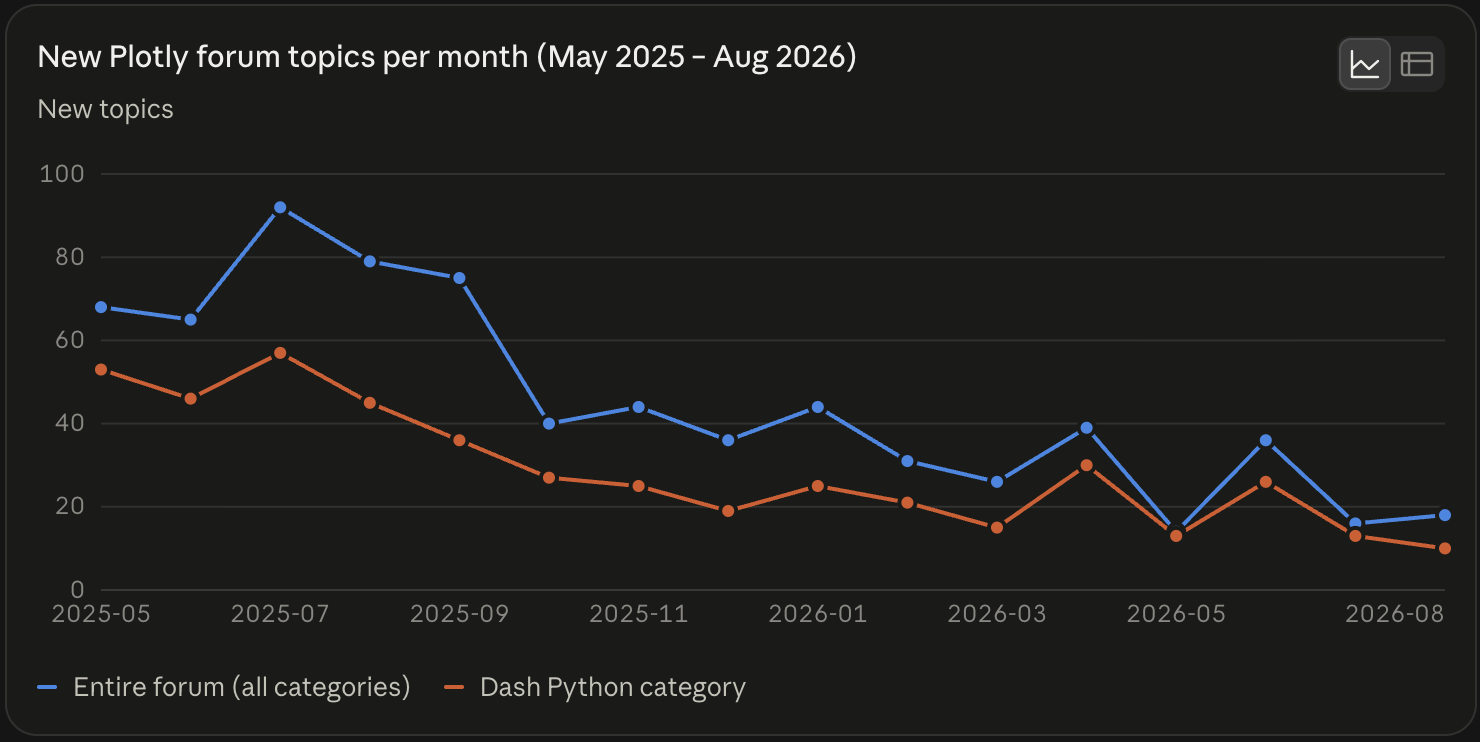
I pulled that directly from the Discourse JSON API. New topics in the Dash Python category dropped from ~50/month in mid-2025 to ~11/month in mid-2026, and median views per new topic fell from ~140 to ~85.

This is difficult for me to make and I feel like i’m just talking to an empty room most of the time. I’d like to start with stating this - The code, the dash framework is in good shape. – Dash 4.x, React 19, FastAPI support and plotly.py 7.0 all shipped recently. You all are amazing engineers but my concern is not that. My concern is governance, community, and the boundary between what’s open and what’s paid. Here’s what I have as concerns and I think a lot of other builders would like answered.


  1. Commitment and roadmap

    • Is Dash committed to remaining MIT-licensed indefinitly? Is there any circumstance under which Plotly would relicense to BSL, SSPL, or a source-available license? :yellow_circle: Mostly answered
    • Is there a published open-source roadmap for Dash separate from the Dash Enterprise release roadmap? If not, will there ever be one? Roadmap - Plotly :yellow_circle: Partially answered
    • How many full-time engineers are funded to work on plotly/dash, plotly.py, and plotly.js specifically, as opposed to Enterprise, Studio, or Cloud? :red_circle: Not answered
    • What is the plan if Plotly is acquired? Would Dash go to a foundation, or would it transfer with the company? :red_circle: Not answered
  2. The open / paid boundary

    • What is the durable line between “this belongs in open-source Dash” and “this belongs in Enterprise/Studio/Cloud”? Is that line written down anywhere a contributor can read before they start building? :red_circle: Not answered
    • Has any capability that previously lived in open-source Dash, or was announced for it, moved into a paid tier? If so, which? :red_circle: Not answered
  3. Community health

    • New topics in the Dash Python forum category have fallen roughly 75% in the last twelve months, and median views per thread are down about 40%. Is the company tracking this? What does it attribute it to? :green_circle: Answered
    • Is there still a community manager role at Plotly? Who holds it, and what is that person resourced to do? :green_circle: Answered / transitional
    • Given that developers increasingly ask coding agents rather than forums — is the forum still the intended home for the Dash community, or is the company deliberately letting it wind down in favor of something else? Either answer is fine; not knowing is the problem. :green_circle: Answered
  4. Contributor economics

    • If Plotly ships first-party functionality that duplicates a widely-used community library, what is the process — is the author told in advance?
      :red_circle: Not answered
    • Is there a path for an independent developer to build a business on Dash that Plotly actively supports rather than competes with? What does that look like concretely? :red_circle: Not answered
  5. Data, IP and AI

    • What are the current terms governing content posted to community.plotly.com? Is that content used to train or fine-tune any model, or included in Plotly AI / Studio retrieval? :yellow_circle: Partially answered
    • Is code submitted in forum posts, GitHub issues, or PRs treated differently from contributed code under the repository license? :red_circle: Not answered
    • Does Plotly Studio or Plotly AI transmit user data or user code off the local machine? The marketing says code stays local during development — what exactly leaves the machine, and when? :red_circle: Not answered
    • If Plotly were acquired or wound down, what happens to forum content, user accounts, and hosted apps on Plotly Cloud? :red_circle: Not answered
  6. Viability and the big asks

    • Reported total funding for Plotly sits under $12M across public sources for a thirteen-year-old company. Is the company profitable, or is it burning? A team betting a five-year roadmap on Dash needs to be able to reason about this.
      :green_circle: Substantively answered
    • Plotly Cloud at $29/seat is a self-serve motion, which is new for this company. Is that now the primary growth bet, and does Dash open source function as the top of that funnel?
      :yellow_circle: Mostly assumed
  • The ask: will someone with roadmap authority — not only community relations — do a public, recorded conversation with the Plotly champions that would like to contribute , on a recurring basis? Quarterly is enough. A single one-off doesn’t fix the single-point-of-contact problem.
    :red_circle: Not answered

Once again I’ll finish with this, the engineering is visibly healthy and more impressive and powerful than ever but the governance and communication is visibly absent. Their is a lot of people that have been here for a long time, people that have placed their careers and years of engineering into what is this open source.

I never graduated college and I started my life at a clear disadvantage. Learning this language, this framework and building alongside it at the start was a difficult but worthwhile path for me to better my life. The industry has many issues, I’d assume you all have your own war stories. The concerns I face are a fleeting path available for others to make careers in this space, a shrinking pool of talent and opportunity and community that I feel like could be corrected. The issues I have are that the company has shaken to a degree it’s un-reconizable.

Anyway this is and has been good-faith, even within the worst of times. I wan’t this community, the company that launched it and those that build within it to succeed. However I feel a responsibility to ask the difficult questions, make a fuss as I drove people to invest in this company, financially, their time, their career. I was one of your biggest cheer leaders, a Plotly Champion and a colleague the issue is you never saw me or others as colleagues only ever customers.

I’ve been looking from the side line what’s going on the past months, you raise a lot of important questions.

A lot of independent developers using Dash build their business around building custom solutions either for internal customers or for external customers (“implementation partners”). Depending on the type of solutions this can either be done without (“free beer” from Plotly) or it can be combined with Plotly’s commercial offerings.

Building a solution on top of someone else’s work always needs a risk/benefit assessment, but Plotly has been around for quite some time and the library is mature. From my perspective this business model is well supported, at least my team is not missing something from Plotly here and I don’t see a big potential for conflicts here.

Building complementary offerings that are of generic “add-on nature” beside Dash is a lot different.

I’m not sure that the Plotly Dash market share and Plotly’s company size is big enough to support such a kind of business.

Even if you look at big enterprises (e.g. Salesforce, Microsoft) that do have such “add-on provider” partnerships and are not limited to implementation partners, transparency and guarantees are often very limited, if they exist at all and most of the time reserved for the few partners that significantly drive license sales.

That being said, I still think that it would be interesting to hear back from Plotly regarding some of your questions!

Don’t need anyone to buy me a free beer or even be a direct supplier for my tap, just think ontap we should have and support more options to market than just Boxer Beer lol From my experiences its as if the province flipped and banned U.S. alcoholic beverages.

I created some nice Tito’s vodka and we are all stuck sitting in a lonely dark room getting drunk off our own supply.

A rising tide raises all ships, a tide pull back lowers all ships. The issue is theirs only a handful left on the water. Some of the issues are self inflicted and some are industry wide.

We have more of the engineering handled by ai, have more free time than ever, yet we cant meet up at the bar and talk. We are facing more difficulties than ever. Its of my opinion we should be opening up more regional based bars, establish supply chains for open source to expand and communicate better rather than isolate. Your bar succeeds, plotly sells more boxer beer and i sell more tito’s and that scales out to support new providers, more engineering, more options and opportunities within the industry.

I’ve broken this framework in the best ways possible, this dash framework isn’t a graphing library its much more capable than that. I build obs systems, video games, e-commerce platforms, iot management systems and components and tools that mostly extend out ways to build something amazing enterprise level outside of a generated chart. You made a lot of good points thanks for jumping in on this.

I totally agree and would love to see an even more thriving community - a major challenge for many projects.

I’m not sure if I get this one right. For example, we do have projects like DMC and DBC where it seems to me that Plotly does definitely not work against them, although they “compete” in some ways with the “Dash Enterprise Design Kit”.

Could you detail that? (might be that I have been too ignorant to things happening lately…)

Not going to elaborate for the moment, doesn’t feel right to just unload on them much further at this moment. Their aware, going to give them time to respond rather than overload.

As the lead maintainer of Dash Mantine Components, I can tell you that Plotly is extremely supportive of community projects.

Here is just one concrete example. The upstream Mantine library made a change to require a context manager (The dmc.MantineProvider). This change resulted in a decrease in performance in dash apps. It was reported here:

This issue did not affect any of Plotly’s own component libraries. It only affected community projects like DMC and FAC (feffery-antd-components)

The Plotly team made a substantial change to Dash Renderer to address the issue. That work became part of the Dash 3.0 release.

This is a clear example of Plotly supporting community projects.

I wish we had the same experiences @AnnMarieW i have a lot of respect for you. However we are not in the same position. Your career isn’t tied or dependent on Plotly the same way my career is. I appreciate you jumping in on this but a 2yr old github pr doesn’t replace the need for clearity or an open dialog between the open source and the company that manages it.

Thank you all for the thoughtful discussion and responses.

Is the Dash Framework in trouble?

It is not. In fact, quite the opposite. Dash’s use is growing thanks to coding agents (downloaded 59M times last month) and we’ve merged more PRs this YTD (209!) with more contributors (50!) than any other year in the last 5 years.

That being said, AI has had a huge impact on Q&A and community building. There’s been a serious decline on community forums across the board, including ours.

Plotly and Dash are at the forefront of a broad shift in analytics from point-and-click GUIs to code-based analytics built with AI. There’s a whole new class of users that can now build with code, and a whole new set of apps that are getting built because it’s cheaper than ever. Across our customer base, we’re seeing instances of customers creating 10-100x the number of applications and users.

But AI is also decimating search and online Q&A communities across the board. Users don’t ask each other questions, they just ask AI. More people are working on their own (with their AI agents) rather than collaborating and working with each other. In open source communities, users are re-inventing the wheel vibing and inlining utility libraries rather than publishing or importing shared utilities to package managers.

In the era of AI, we believe in strong frameworks. A vast amount of enterprise software and analytics will be rewritten over the next decade and a good framework gives you more intelligence / dollar than any model upgrade. A good framework abstracts away the bits that you don’t need to care about and exposes the bits that you do, and that’s what continues to drive us forward with Dash. Just this year, we’ve evolved Dash into an MCP framework, built a cloud service for community members to share apps (for free! filling the gap for the community that Heroku left), shipped our 275th release of plotly.js, shipped websocket support for Dash, enabled users to add chatbots to their app with a single click, shipped an agentic analytics product for creating Dash apps (Plotly Studio), and shipped a major overhaul to our enterprise platform to support 10x the number apps getting built in this new AI era.

We’re shipping more than ever because Plotly the company is in a great place. We’re unlike most other startups in that we don’t rely on precarious “raise and burn” funding cycles; we operate on the income from our customers and haven’t needed to raise money in several years. I really can’t emphasize enough how rare this is in the industry. And as open source stewards, we’re coming into our 10th year of maintaining Dash and our 14th year of Plotly.js. This longevity in support and funding is also rare among open source projects; so many projects are either maintained by a couple of solo developers who are stretched very thin or corporations where the library commodifies their complement (e.g. Kubernetes). And at the end of the day, all of our open source work is MIT-licensed, which is the most permissive open source license out there. We chose this license 13 years ago - very early on in Plotly’s journey - and we were very intentional about this decision. We wanted this software to be able to live on forever.

I mention both the open source offerings alongside our enterprise offerings because we value them equally. I want Dash and Plotly to be ubiquitous and available to anyone in the world with an internet connection. Before Plotly, technical data visualization was only available to users who could pay thousands of dollars for a MATLAB or SAS license and were hopelessly tied to the desktop, impossible to share. But to use this technology to be actually used in any major organization, it needs to be accompanied by a platform with enterprise functionality. We do both. And from a business perspective, we’ve designed the incentives of these product suites to be aligned. Here is an essay I wrote 6 years ago about how I think about what should be open source vs what should be enterprise, and it’s remained true since then: 📔 Dash Enterprise Fieldnotes #1 - Why Dash Enterprise?.

Our governance and development structure in open source has remained pretty constant over the last 13 years. We hold the roadmap with a loose grip, and try not to make too many public commitments and over promise. This is a tricky balance to find, and I recognize that it can come at the expense of predictability.

As we all know, AI is remarkable at writing Python, Plotly, and Dash code. The content from our documentation and this forum has likely been scraped by every model provider. In the early days of ChatGPT 3, I remember feeling so shocked to see the AI repeat back to me words that I originally wrote in our documentation. In today’s RLVR world, the models are likely getting better at building Dash and Plotly code by writing and training on examples in their own autonomous loops, independently of the forum. We didn’t have any explicit data sharing arrangements for this to happen, it just happened through their scraping; the forum isn’t a walled garden.

Despite all of this, community in the AI era will look different. After I released Dash in 2017, I made a point to read and answer every single question in the community forum. Many others started paying it forward and answering each other’s questions once they got help the first time. Q&A was the entry point to connection and this forum was the meeting place of Dash. This took several hours each day, and we eventually hired Adam to take over. He did an amazing job running this and recently moved abroad to new ventures. As we look for someone to fill his role, I’m stepping back into the community. I’m also working on ways for others at Plotly (the people that build the software) to step in and share more as well.

But now that AI has taken over Search and Q&A, we’re missing the entry point to this meeting place. We’ve been putting time into other channels: IRL events (I co-hosted an event in San Francisco for a few hundred people in the spring, and we’ve done a dozen smaller roadshows around the world this year), web events hosted by the engineers of the features (we run these about once a month), social media (although this always veers more promotional). Personally, I’ve started writing again (chris-parmer.com) and sharing some of that writing here in the forum.

Perhaps the forum will have its second life as a place for discourse, sharing, and connection rather than Q&A. This will be smaller, but it could be a nice reprieve from our days spent with our agents.

This is quite normal. Most people are gradually adapting to solving problems with advanced AI tools. It is an inevitable trend that there will be fewer problem-discussion posts on forum websites. In the future, forum content should focus more on showcasing various functional case studies of applications built with AI, as well as how to leverage AI to accelerate Dash application development.

I agree that AI is changing how people solve coding problems. I think forums can still be useful if developers share real projects, examples, and the problems they faced while building them. For Dash, practical AI-assisted app examples would be especially useful.

I can see where you’re coming from. Having an old GitHub PR available is useful, but it doesn’t really replace clear communication with the people maintaining the project. An open discussion would probably help both the community and the company understand each other’s concerns better.

Great post @chriddyp, thank you for sharing your views.

I learned Plotly Express, graph_objects, and Dash almost entirely through this community forum. Even though I’m not as active these days for the reasons you mentioned, I still use Plotly every single day. I’m definitely responsible for a handful of those downloads each month just from sharing code with colleagues.

Knowing the APIs well has become even more valuable in the AI era. Sometimes the biggest unlock in an AI‑assisted dashboard is simply knowing what to ask and what’s possible.

I attended the last two Plotly events in San Francisco, and both were incredibly worthwhile. Now with lower forum traffic, I strongly recommend attending any Plotly event to anyone if the opportunity arises. The tech is powerful, the staff is genuinely friendly, and it’s inspiring to see what the team is building. There aren’t many things I wouldn’t cancel to make it to one.

And thank you @chriddyp for acknowledging Adam’s contributions. Many of us learned a tremendous amount from his weekly virtual sessions, and his impact on the community was huge. Shoutout to my FFF’s (Figure Friday Friends).

Excited for Plotly and for this community. I genuinely believe a great future is ahead for all of us.